
 Kate Margallo
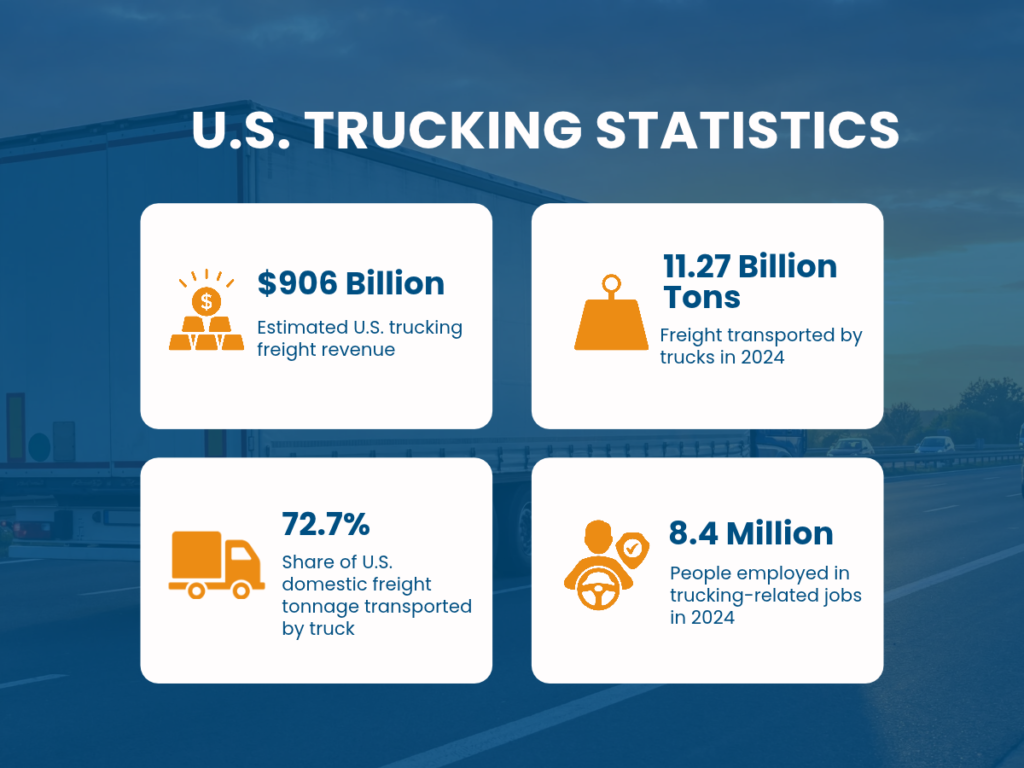
The U.S. trucking industry generated an estimated $906 billion in gross freight revenue in 2024, transporting 11.27 billion tons of freight across the country.
That means trucks carried approximately 72.7% of U.S. domestic freight by weight, making trucking the dominant freight transportation mode in the United States.
The industry is also considerably larger than the major trucking companies seen on America’s highways might suggest. More than 91% of motor carriers operate 10 trucks or fewer, while more than 99% operate fewer than 100 power units.
Below are the latest U.S. trucking statistics covering freight, employment, truck drivers, wages, small businesses, international trade, safety, and the industry’s outlook.
Key U.S. Trucking Statistics
- $906 billion: Estimated U.S. trucking freight revenue in 2024.
- 11.27 billion tons: Freight transported by trucks in 2024.
- 72.7%: Share of U.S. domestic freight tonnage transported by truck.
- 76.9%: Share of freight transportation revenue generated by motor carriers.
- 8.4 million: People employed in trucking-related jobs in 2024.
- 3.58 million: Professional truck drivers employed across the wider U.S. economy in 2024.
- 2.06 million: Heavy and tractor-trailer truck drivers employed in May 2025 under the narrower BLS occupational definition.
- $59,710: Mean annual wage for heavy and tractor-trailer truck drivers in May 2025.
- 91.5%: Motor carriers operating 10 trucks or fewer.
- 99.3%: Motor carriers operating fewer than 100 power units.
- $1.039 trillion: Value of U.S. freight transported by truck across the Canadian and Mexican borders in 2025.
- $104.4 billion: U.S.–Canada and U.S.–Mexico freight transported by truck in June 2026 alone.
- 237,600: Average annual heavy and tractor-trailer truck-driver job openings projected between 2024 and 2034.
These figures illustrate both the scale and fragmentation of American trucking: it is simultaneously a nearly trillion-dollar freight industry and an industry overwhelmingly composed of comparatively small carriers.
How Big Is the U.S. Trucking Industry?
The U.S. trucking industry generated an estimated $906 billion in gross freight revenues in 2024, according to the American Trucking Associations (ATA).
That was down 9.8% from the $1.004 trillion generated in 2023.
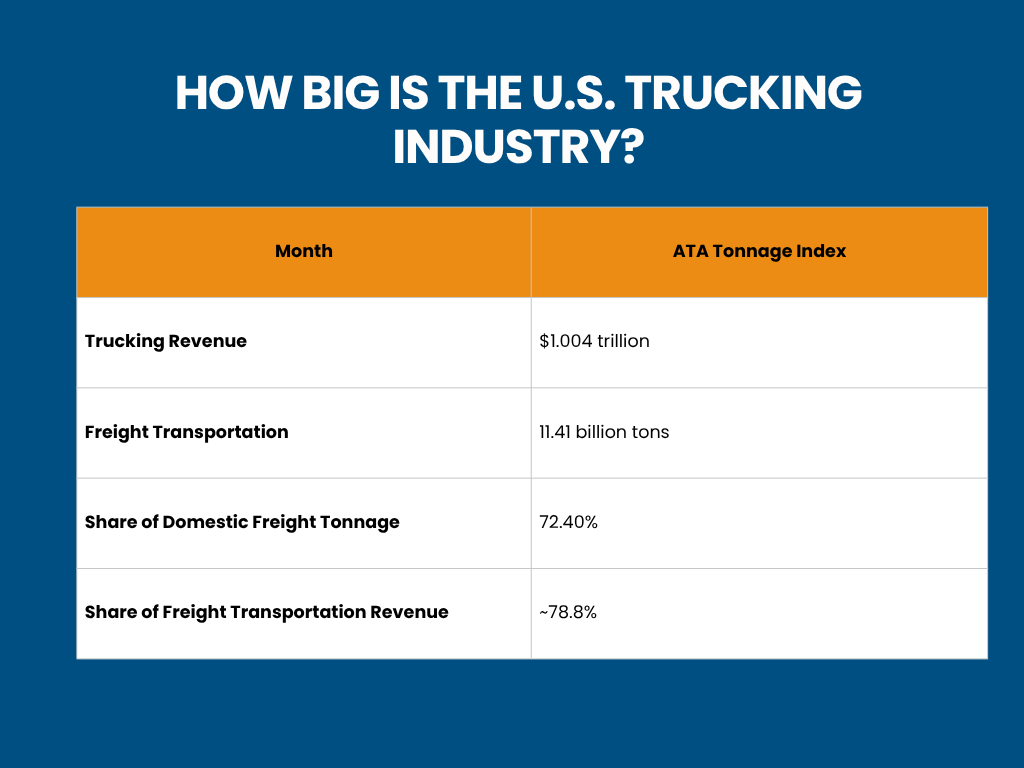
Freight volume also declined, although considerably less dramatically. Trucks transported 11.27 billion tons in 2024, compared with 11.41 billion tons in 2023, representing a decline of approximately 1.2%.
The difference between the decline in revenue and the decline in tonnage is noteworthy. Trucking revenue fell much more sharply than the physical amount of freight transported.
What Percentage of U.S. Freight Is Transported by Truck?
Approximately 72.9% of U.S. domestic freight tonnage was transported by truck in 2024.
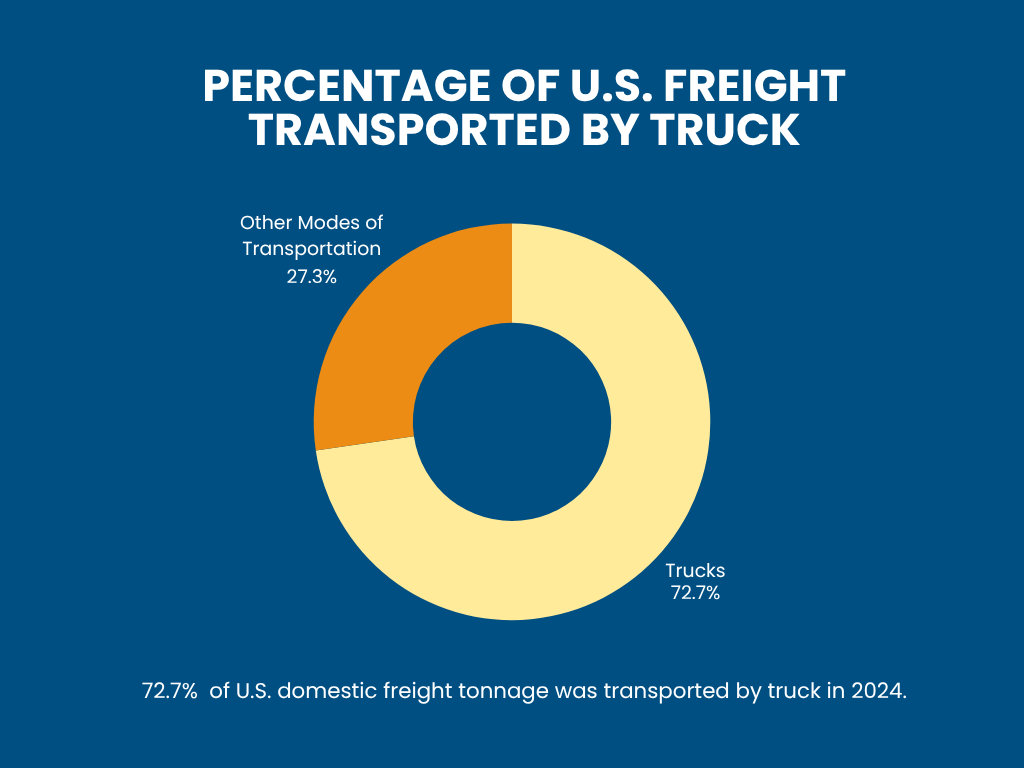
Trucks therefore carried almost three out of every four tons of domestic freight moved in the United States.
Motor carriers also generated approximately 76.9% of the revenue earned across freight transportation modes, with estimated gross freight revenue of $906 billion.
This dominance helps explain why trucking conditions are often treated as an indicator of the wider U.S. economy. Trucks transport manufactured goods, retail products, food, construction materials and countless other commodities moving through American supply chains.
How Much Freight Do U.S. Trucks Move?
American trucks transported approximately 11.27 billion tons of freight in 2024.
That works out to roughly:
- 30.9 million tons per day
- 1.29 million tons per hour
- 21,400 tons per minute
These figures are derived from ATA’s annual estimate and are intended to illustrate the scale of freight movement rather than suggest freight is distributed evenly throughout the year.
The 2024 total was down from 11.41 billion tons in 2023, a decrease of roughly 140 million tons.
Is U.S. Trucking Growing in 2026?
Freight conditions have remained mixed in 2026.
The ATA’s seasonally adjusted For-Hire Truck Tonnage Index stood at 114in July 2026, with 2015 equal to 100.
July tonnage declined 1% from June and was 0.5% lower than July 2025.
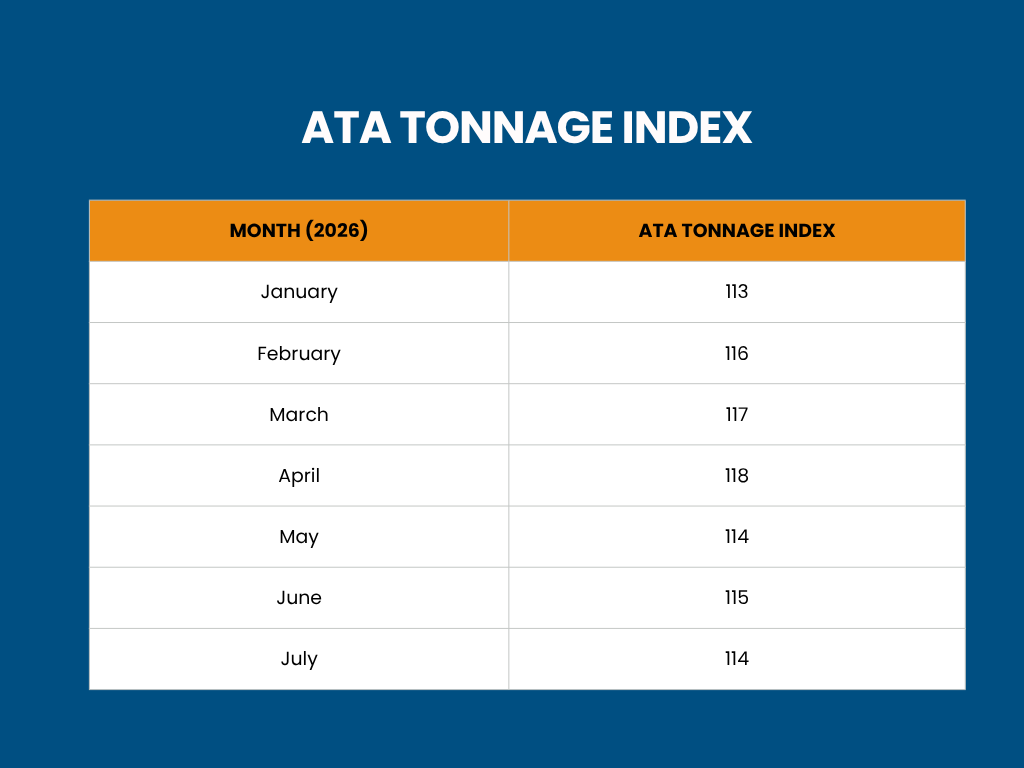
However, trucking tonnage during the first seven months of 2026 remained 1.4% higher than during the same period of 2025.
The figures point to a trucking market experiencing a modest but uneven recovery rather than a straightforward freight boom.
How Many Truck Drivers Are There in the U.S.?
There isn’t a single correct answer to this question because different organizations define “truck driver” differently.
The American Trucking Associations estimates that there were approximately 3.58 million professional truck drivers in the United States in 2024.
The Bureau of Labor Statistics uses narrower occupational classifications. Its May 2025 Occupational Employment and Wage Statistics estimated:
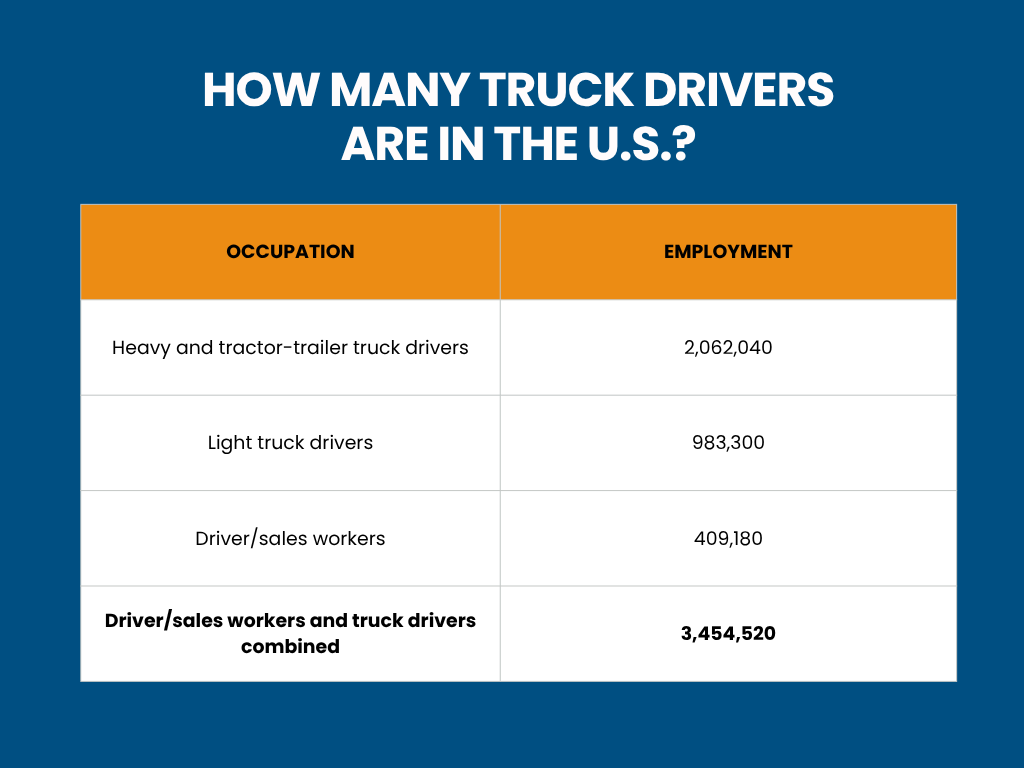
This distinction matters when quoting trucking statistics.
Saying there are “2.06 million truck drivers” refers specifically to BLS’s heavy and tractor-trailer truck driver category. It does not represent everyone who drives a truck professionally.
Most Trucking Companies Are Small Businesses
Despite the enormous amount of freight transported by the industry, American trucking is highly fragmented.
Approximately:
- 91.5% of motor carriers operate 10 trucks or fewer
- 99.3% operate fewer than 100 power units
Put another way, only around 8.5% of carriers operate more than 10 trucks, while less than 1% operate 100 or more power units.
This is one of the defining characteristics of American trucking: a $906 billion industry is supported by a huge population of small fleets and owner-operators alongside a comparatively small number of enormous national carriers.
Trucking and U.S. International Trade
Trucking’s importance extends beyond domestic freight.
In 2025, trucks transported approximately $1.039 trillion worth of freight between the United States and Canada and Mexico, according to the Bureau of Transportation Statistics.
That was up 0.7% from 2024.
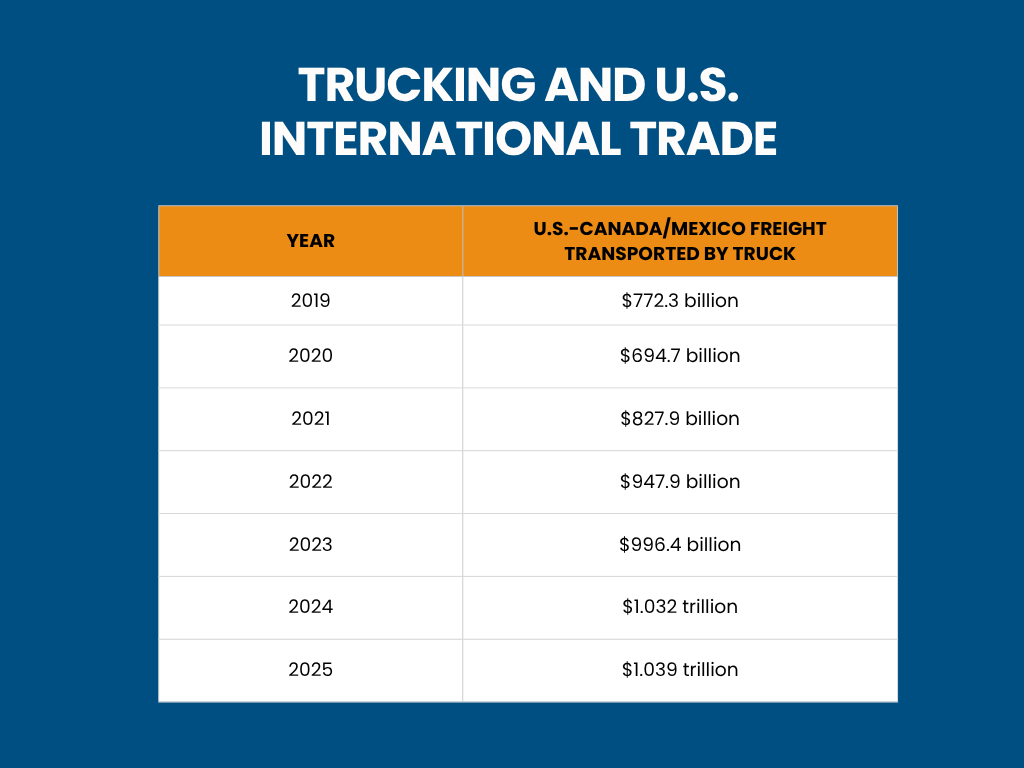
Truck freight across the two borders has therefore increased by approximately 34.5% since 2019 in nominal dollar terms.
The figures are not adjusted for inflation, so this should not be interpreted as a 34.5% increase in the physical volume of goods transported.
Trucks Now Carry More Than $1 Trillion in North American Cross-Border Freight
The $1 trillion threshold is particularly notable.
In 2025, total U.S. freight trade with Canada and Mexico amounted to approximately $1.6 trillion across all transportation modes. Trucks alone moved just over $1.039 trillion.
Trucking accounted for 55.7% of U.S.–Canada trade by value and 73.6% of U.S.–Mexico trade by value.
The dependence is particularly pronounced at the southern border, where nearly three-quarters of U.S.–Mexico freight value moves by truck.
The Busiest U.S. Truck Border Crossings
Border freight is highly concentrated around several major trade gateways.
For trade with Canada, the leading truck ports include:
- Detroit, Michigan
- Port Huron, Michigan
- Buffalo, New York
For trade with Mexico, the leading truck ports include:
- Laredo, Texas
- El Paso, Texas
- Otay Mesa, California
Laredo stands out in particular. In May 2026, approximately $35.3 billion in freight across all reported modes passed through Laredo, making it the largest port listed in BTS’s North American transborder data for that month.
Medium- and heavy-duty vehicles make up a relatively small share of vehicles on U.S. roads but a considerably larger share of transportation emissions.
Trucking and Greenhouse Gas Emissions
Medium- and heavy-duty vehicles make up a relatively small share of vehicles on U.S. roads but a considerably larger share of transportation emissions.
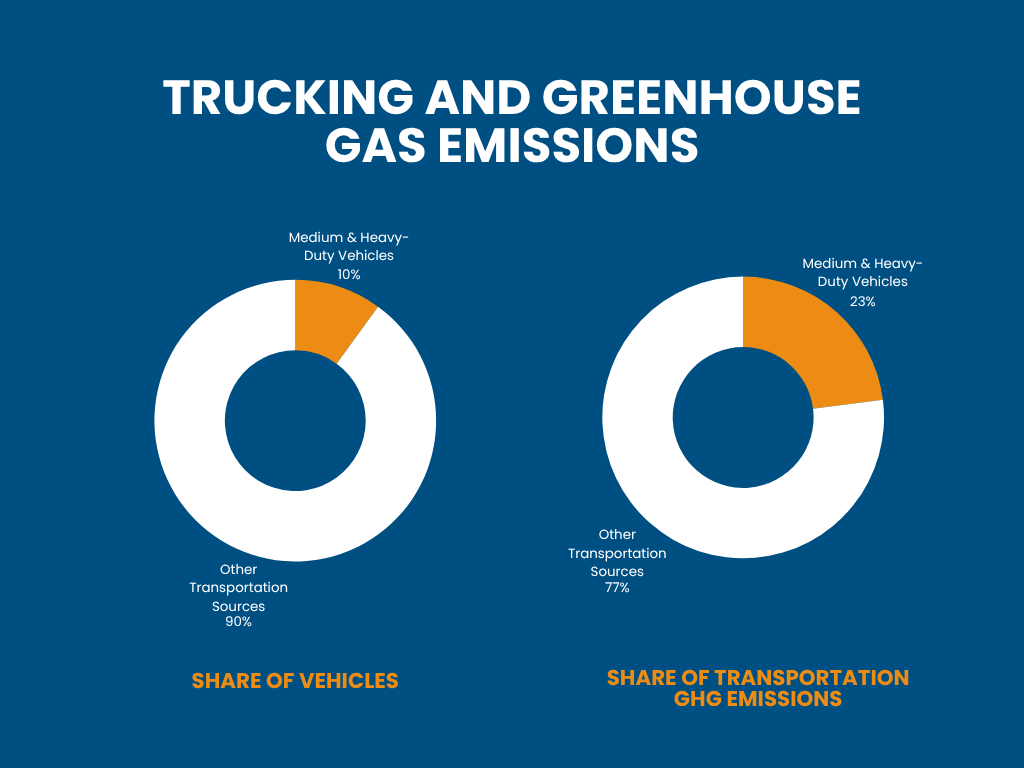
According to the Environmental Protection Agency, medium- and heavy-duty vehicles account for approximately 10% of vehicles on U.S. roads but 23% of greenhouse gas emissions from the transportation sector.
This imbalance is one reason fuel efficiency, zero-emission trucks and alternative powertrains have become increasingly important issues for the industry.
EPA has also reported that more than 3 million Class 6 and Class 7 vehicles — including delivery trucks, refuse trucks, utility vehicles and school buses — are currently in operation.
The Future of U.S. Trucking
The trucking industry is unlikely to become less important to the American economy in the foreseeable future.
BLS expects heavy truck-driver employment to grow through 2034, while the growth of e-commerce is expected to increase demand for light-truck delivery drivers.
At the same time, the industry is changing.
Fleet electrification, autonomous trucking technology, tighter emissions standards, artificial intelligence, route optimization and changing international trade patterns are all influencing how freight moves.
But the industry’s current structure remains strikingly traditional: millions of drivers, hundreds of thousands of carriers and an overwhelming dependence on small trucking businesses move almost three-quarters of America’s domestic freight tonnage.
Moving a Vehicle? Shiply Can Help
Trucking keeps America moving, and that includes the millions of vehicles transported across the country each year. Whether you’re shipping a car across a state or across the U.S., Shiply makes it easy to compare quotes from rated vehicle transport providers already traveling along similar routes.
Simply tell us what you need to move and where it needs to go, then compare quotes and feedback from transport providers in one place. Get a quote with Shiply and find the right transport provider for your move.
Sources: The Broker Shop · Bureau of Transportation Statistics · American Trucking Associations · Successor Inc. · Bergey’s Truck Centers